
Case history: a compact electric solution for moving 60–70-tonne railway wagons in confined spaces
To move a railway wagon without using a forklift, a compact electric mover can be used, provided that the system is correctly sized according to the actual force required to move the wagon on rails.
This was the challenge faced by a major company in the railway sector, where railway wagons weighing approximately 60–70 tonnes had to be moved within an industrial facility with very limited manoeuvring space.
The main challenge was to find a solution capable of moving such heavy loads without introducing the footprint of a forklift into the working area.
The challenge: moving 60–70 tonnes in confined spaces
When the space available around a railway wagon is limited, the size of the equipment used for handling can become a significant constraint.
The company therefore needed a solution that was compact and easy to integrate into the existing production layout, while keeping the overall footprint to a minimum during movement.
In a railway application, the weight of the wagon is not the only factor to consider. It is also essential to evaluate how the handling system interacts with the load and how much space it requires during manoeuvres.
The solution: Robik Q130 underneath the railway wagon
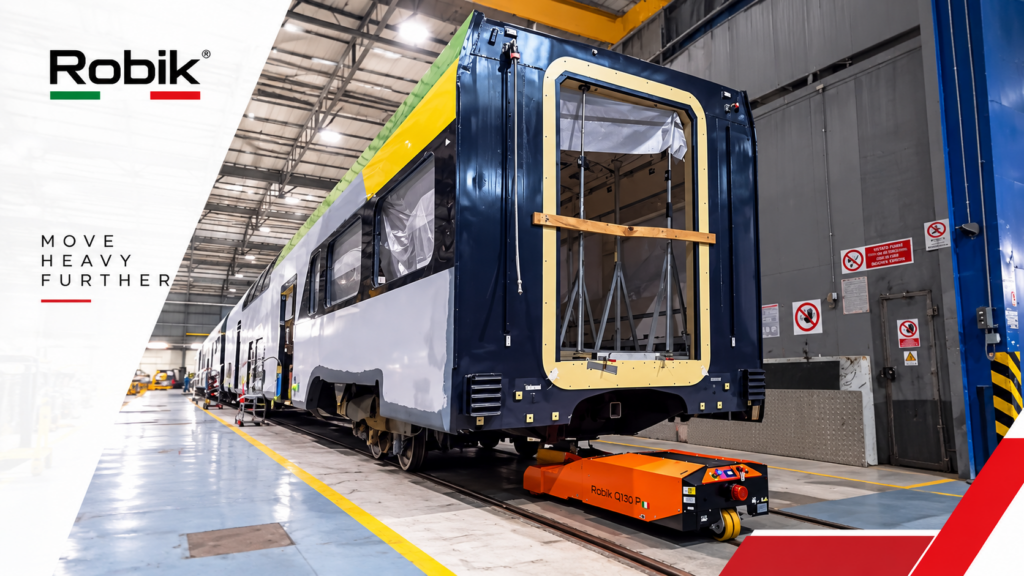
For this application, Robik Q130, a radio-controlled electric mover, was used.
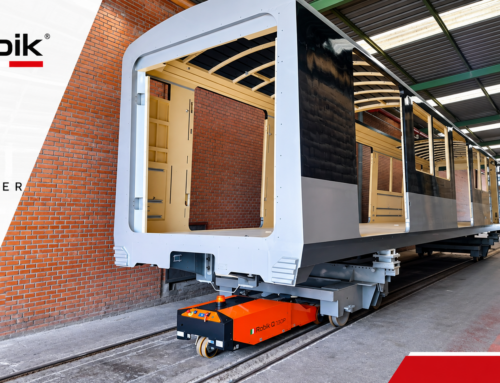
One of the key advantages of the solution is the ability to position Robik underneath the railway wagon, making use of otherwise unused space and significantly reducing the overall footprint of the handling system.
This allows Robik Q130 to move the wagon along the track with a very compact configuration, particularly suitable for confined spaces within the facility.
The radio remote control also allows the operator to choose the most suitable position during movement, maintaining good visibility of the wagon, the track and the surrounding area.
How can a compact mover move a 60–70-tonne railway wagon?
The total weight of a railway wagon does not correspond to the force required to move it.
In railway applications, the contact between steel wheels and steel rails results in relatively low rolling resistance. As a result, the force required to set a wagon in motion can be significantly lower than its total weight.
After correctly sizing the application, this principle makes it possible to use compact systems to move railway wagons weighing 60–70 tonnes.
Weight, gradient, track conditions and rolling resistance must always be evaluated to determine the actual tractive force required.
The results
The introduction of Robik Q130 made it possible to:
- move railway wagons weighing approximately 60–70 tonnes;
- operate in confined manoeuvring spaces;
- reduce the overall footprint by positioning the mover underneath the wagon;
- perform these movements without using a forklift;
- improve visual control of the operation thanks to the radio remote control;
- integrate the solution into the existing production layout.
What should be considered when moving a railway wagon?
Wagon weight is only one of the parameters to consider. When selecting a railway handling system, it is also necessary to evaluate rolling resistance, track gradient and conditions, available space and the way the mover interacts with the wagon.
The low rolling resistance of the wheel-rail system makes it possible to move very heavy loads with forces significantly lower than their total weight. However, each application must be correctly sized according to its actual operating conditions.
Do you need to move railway wagons in confined spaces?
Every application has different requirements. Wagon weight, track characteristics, gradient and available space should be analysed together to determine the required force and identify the most suitable configuration.
Do you have a similar railway handling challenge? Contact Robik: we can analyse your application and evaluate the most suitable solution together.