
Case history: from crane truck handling to a radio-controlled electric system for lifting, towing and pushing a container weighing approximately 36 tonnes along the production line
When moving heavy containers within an industrial facility, load weight is not the only factor to consider. Available space, direction of movement, handling frequency and the need to integrate the container into the production process are all key elements when choosing the most suitable handling system.
This was the challenge we faced at a company specialising in the customisation of containers designed to accommodate gas cylinders and gas systems, where containers weighing approximately 36 tonnes had to be moved along the production line.
Previously, the company relied on a rented crane truck to carry out these handling operations.
The challenge: moving heavy containers along the production line
Container handling was not an occasional operation but an integral part of the production process.
Using a crane truck made it possible to perform the required movements, but meant organising and renting an external vehicle every time the container needed to be moved.
The company therefore needed a dedicated solution available directly within the facility, capable of moving a container weighing approximately 36 tonnes and adapting to the different directions required by the production process.
The solution: Robik Q130 to lift and move the container
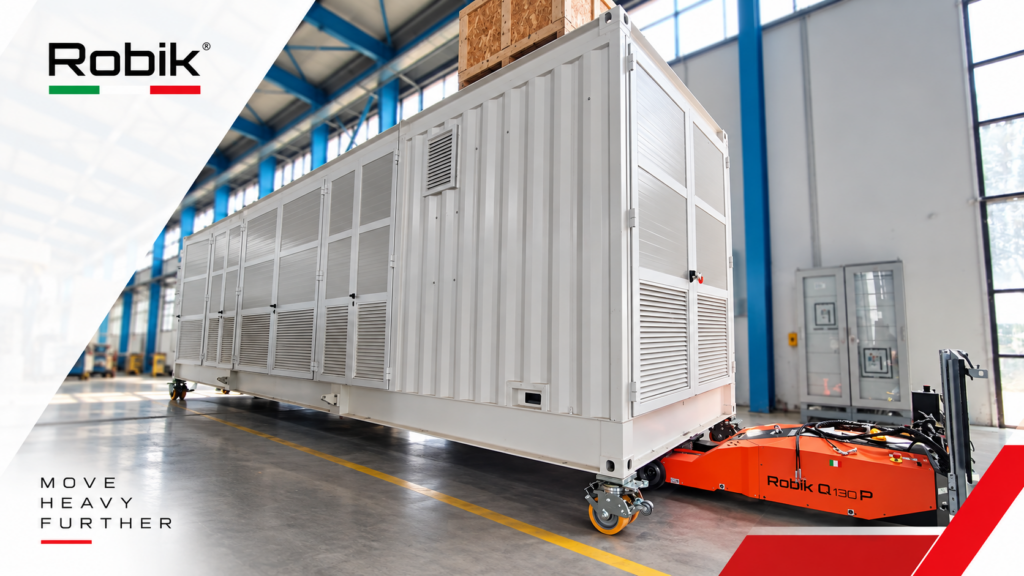
After analysing the application, Robik Q130, a radio-controlled electric mover configured to interact directly with the container, was introduced.
The system makes it possible to lift the container and then move it by towing or pushing, without having to rely on a crane truck every time an internal movement is required.
The radio remote control also allows the operator to choose the most suitable position during manoeuvres, maintaining good visibility of the container, the route and the surrounding area.
More than towing: handling from the long side
One of the key aspects of this application is the ability to adapt container handling to the requirements of the production line.
In addition to towing and pushing, the configuration also allows the container to be handled from its long side, enabling lateral movements required for positioning during different stages of production.
This flexibility makes it possible to perform different manoeuvres using the same handling system, without restricting the production process to a single direction of movement.
The results
The introduction of Robik Q130 enabled the company to:
- move containers weighing approximately 36 tonnes;
- have a dedicated handling system always available within the facility;
- avoid relying on crane truck rental for internal handling operations;
- perform both towing and pushing movements;
- handle the container from its long side;
- increase flexibility when moving containers along the production line;
- maintain better visual control during manoeuvres thanks to the radio remote control.
What should be considered when moving a container within an industrial facility?
This case shows that when a container becomes part of a production process, selecting the right handling system requires considering much more than its weight alone.
Total weight, floor conditions, manoeuvring space, directions of movement, handling frequency and the method used to lift and interact with the container should all be evaluated.
A dedicated solution can be particularly useful when container handling is frequent and becomes an integral part of the production process, reducing dependence on external equipment and increasing operational flexibility.
Do you need to move heavy containers within your facility?
Every application has different requirements. Container weight, route, available space and handling method should be analysed together to identify the most suitable configuration.
Do you have a similar material handling challenge? Contact Robik: we can analyse your application and evaluate the most suitable solution together.