

Case history: moving a 32-tonne wheeled load in confined spaces by eliminating the articulated connection and using Robik Q130 to lift and move the load directly.
Moving heavy loads within an industrial facility without using a forklift is possible when the load is positioned on a trolley, wheeled platform or movable structure and the application is correctly sized.
This was the case at a company specialising in tube manufacturing, where a wheeled load with a total weight of approximately 32 tonnes had to be moved within production areas with limited manoeuvring space.
The challenge was not simply the weight. The system previously used to move the load increased the overall footprint, making manoeuvres particularly difficult within the available space.
The challenge: moving 32 tonnes in confined spaces
The wheeled load was moved using a large forklift connected to it through an articulated coupling, both for towing and pushing operations.
Although this configuration made it possible to move the load, it significantly increased the overall footprint of the system. In the confined spaces of the facility, negotiating corners and changing direction was already difficult during towing operations.
During pushing manoeuvres, the challenges increased further: in addition to the space constraints, the position of the forklift in relation to the load made the movement more difficult to control and introduced additional safety-related challenges.
The objective was therefore to find a solution capable of moving the 32-tonne load both by towing and pushing, while reducing the overall footprint and providing better control when manoeuvring within the available space.
The solution: Robik Q130 positioned underneath the load
For this application, Robik Q130, a radio-controlled electric mover, was introduced.
The main difference compared with the previous configuration lies in the way Robik interacts with the load.
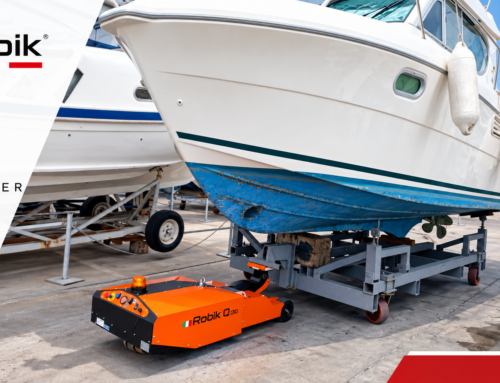
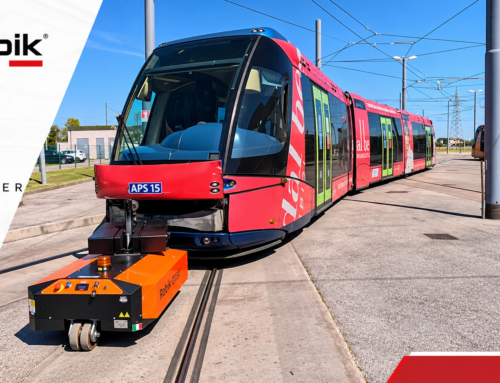
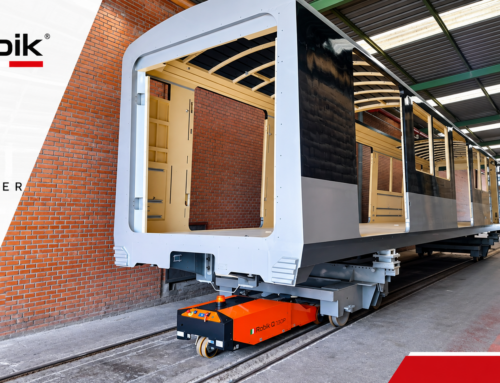
Instead of being connected to the wheeled structure through an external articulated coupling, Robik Q130 positions itself underneath the structure, lifts it and moves it directly.
This made it possible to eliminate the articulated coupling, reducing the distance between the handling system and the load and creating a more compact overall configuration.
This proved to be a key factor when manoeuvring within the confined spaces available inside the facility.
A more compact configuration for towing and pushing
With the previous configuration, the forklift and articulated coupling required additional space beyond the footprint of the wheeled load, affecting the geometry of manoeuvres during both towing and pushing.
With Robik Q130, the mover is positioned underneath the load, eliminating the additional space previously required by the coupling.
The load can therefore be moved both by towing and pushing with a more compact configuration, an important advantage when the route includes narrow aisles, tight corners and limited manoeuvring space.
The radio remote control also allows the operator to choose the most suitable position during movement, maintaining good visibility of the load, the route and the surrounding area.
The results
The introduction of Robik Q130 addressed the main constraints of the application:
- handling a wheeled load weighing approximately 32 tonnes;
- eliminating the articulated coupling, reducing the overall footprint of the system;
- improved manoeuvrability in confined spaces;
- ability to tow and push the load using a more compact configuration;
- eliminating the need, for this specific handling operation, for the heavy forklift previously used;
- improved visual control of the operation thanks to the radio remote control;
- better adaptation of the handling system to the existing production layout.
When can a heavy load be moved without a forklift?
This case shows that a forklift is not necessarily the only solution for every heavy-duty industrial handling operation.
When a load is already positioned on wheels, trolleys or other movable structures, an electric mover designed for towing and pushing can be considered.
However, the choice must always start with an analysis of the actual application. Total load weight, wheel characteristics, rolling resistance, floor conditions, gradients, manoeuvring space and the way the mover interacts with the load all determine the force required and the most suitable configuration.
In this case, redesigning the connection between the mover and the wheeled load made it possible not only to move a 32-tonne load, but above all to reduce the overall footprint and improve manoeuvrability within the available space.
Do you need to move a heavy load without using a forklift?
Every application has different requirements. Before selecting a handling system, the load, trolley, wheels, route and actual manoeuvring space should all be carefully evaluated.
Do you have a similar handling challenge? Contact Robik: we can analyse your application and evaluate the most suitable solution together.