
Case history: a Robik Q130 configured with ballast and a lifting plate to adapt tractive force and handling method to different operating conditions
To determine how much force is required to move a railway wagon or tram, knowing the vehicle’s weight alone is not enough. The required force also depends on rolling resistance, track conditions, gradient and the available traction between the mover and the ground.
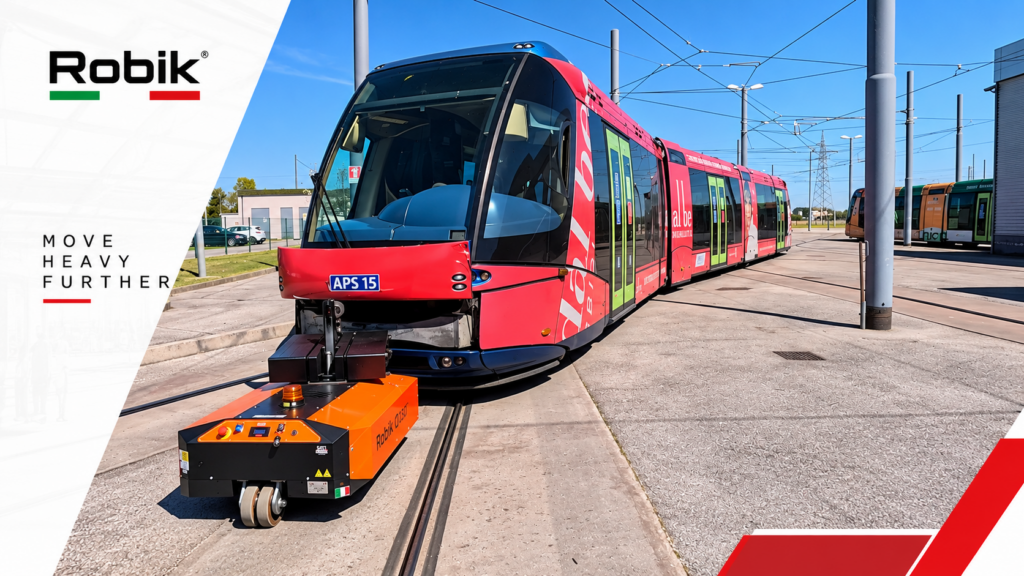
This principle was at the heart of an application developed for a company in the public transport sector, which needed to move trams undergoing maintenance both inside and outside its workshop.
However, the operating conditions were very different and required the same Robik unit to work with two different configurations.
The challenge: towing a non-operational tram inside the workshop
The first requirement involved trams undergoing maintenance that were not operational and therefore had to be towed inside the workshop.
In this situation, there was not enough clearance underneath the tram for Robik to position itself below the vehicle and use its lifting plate.
The tram therefore had to be moved by towing, which required a high level of tractive force.
The solution was to design a Robik Q130 configuration equipped with ballast.
The additional mass increases the load on the drive wheels and therefore the available traction, allowing the mover to transfer greater tractive force to the ground.
Why does ballast increase tractive force?
This is a key principle when sizing a railway handling system.
Increasing motor power alone does not necessarily mean that more force can be applied to the load. To transfer that force to the ground, the drive wheels must have sufficient traction.
Ballast increases the weight acting on the mover and therefore the ability of the drive wheels to transfer the available force without losing traction.
In this application, where Robik could not use the tram’s weight through the lifting plate, the ballast provided the traction required for towing.
Outside the workshop, the configuration changes: the lifting plate comes into use
When the tram leaves the workshop, the operating conditions change.
The vehicle is operational and its suspension system increases the available ground clearance, allowing Robik Q130 to position itself underneath the tram.
At this point, the lifting plate can be used.
By partially lifting the vehicle, part of its weight is transferred onto the mover. This increases the load on Robik’s drive wheels and, consequently, the traction available for movement.
The same configuration can also be used for bus handling, provided that there is sufficient ground clearance for Robik to position itself underneath the vehicle.
Twin wheels for greater stability around the tracks
For outdoor handling operations, a twin-wheel configuration was also adopted.
The presence of the rails and the characteristics of the operating area required a solution capable of providing greater stability during movement.
Robik Q130 was therefore configured not only according to the required force, but also according to the actual conditions of the route.
One Robik, two handling methods
The result is a versatile solution that can adapt to different operating conditions:
- inside the workshop, Robik Q130 uses ballast to provide the traction required to tow a non-operational tram;
- outside the workshop, when ground clearance allows, Robik can position itself underneath the vehicle and use the lifting plate;
- the twin-wheel configuration provides greater stability when operating around railway tracks;
- the lifting plate also allows the system to be used for handling buses with sufficient ground clearance.
How much force is actually required to move a railway wagon or tram?
The answer cannot be determined simply from the vehicle’s weight in tonnes.
To calculate the required tractive force, several factors must be considered, including vehicle weight, rolling resistance, gradient, route conditions and available traction.
It is also important to distinguish between the force required to move the load and the force that the mover can actually transfer to the ground without losing traction.
This is why two vehicles with the same weight may require different handling configurations.
Do you need to calculate the force required to move a railway wagon, tram or other rail vehicle?
Every application should be assessed according to its actual operating conditions. Weight, wheels, track conditions, gradient, rolling resistance, traction and the possibility of transferring part of the vehicle’s weight onto the mover all contribute to determining the most suitable configuration.
Do you have a similar railway handling challenge? Contact Robik: we can analyse your application and evaluate the required force and the most suitable configuration together.