
Case history: from moving engines and axles with 4–5 operators to a radio-controlled electric system designed to handle heavy loads even in confined spaces.
Moving heavy loads within an industrial facility can become particularly challenging when production areas were designed many years ago, while the size of the products and components being handled has progressively increased.
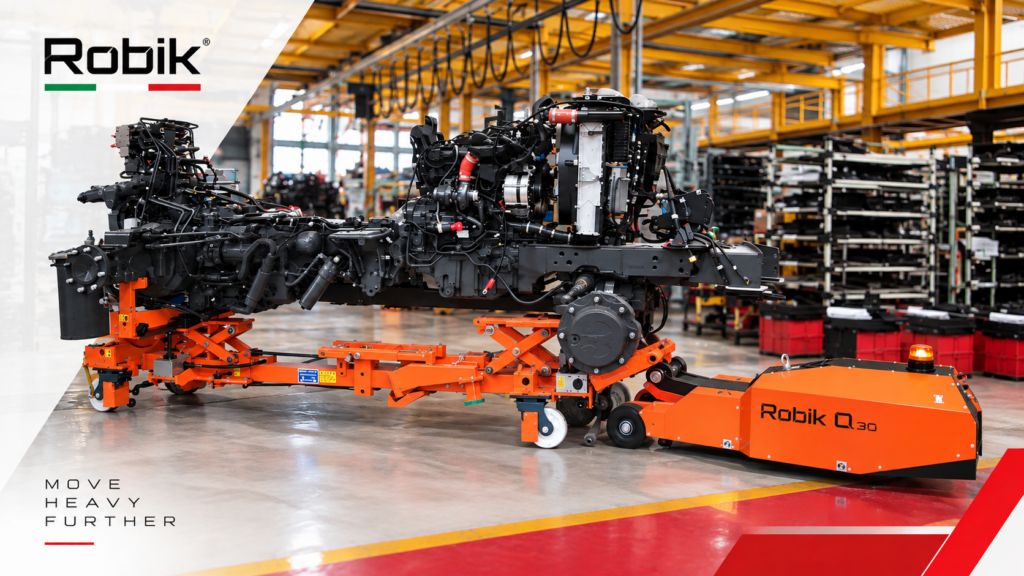
This was the challenge we faced at a facility in the earthmoving machinery sector, where heavy engines and axles had to be transferred between different production areas through confined spaces and tight corners.
Each movement required the involvement of 4–5 operators. The objective was therefore to find a simpler and faster solution capable of operating within the existing space while optimising the resources involved.
The challenge: moving heavy loads in confined spaces
Many existing industrial facilities face a similar situation: the production layout remains largely unchanged, while machinery, components and products increase in size.
In this case, the challenge was not simply the weight of the engines and axles. The main constraint was the limited space available for manoeuvring.
Narrow aisles and tight corners made it difficult to transfer loads between different production areas. A compact and manoeuvrable system was therefore required, capable of being integrated into the existing production process without substantial modifications to the facility layout.
The solution: Robik Q30 for moving engines and axles
After analysing the application, Robik Q30, a radio-controlled electric mover for industrial load handling, was introduced.
One of the key features for this application was its ability to negotiate the tight corners along the route.
Thanks to a steering angle of up to approximately 80–85°, Robik Q30 can perform very tight changes of direction and move loads even where manoeuvring space is limited.
Another important feature is the radio remote control. The operator is not restricted to a fixed position on the machine and can move around the load, choosing the position that provides the best visibility of the load, the route and the surrounding area.
As a result, the same operation that previously required 4–5 people can now be managed by a single operator.
The results
The introduction of Robik Q30 addressed the main challenges of the application:
- Optimised use of resources, reducing the operation from 4–5 people to a single operator;
- Faster load movements, thanks to the ability to negotiate tight corners and confined manoeuvring spaces;
- Greater control during handling, with the radio remote control allowing the operator to choose the position that provides the best visibility;
- Ease of use, reducing the need to coordinate several people during each transfer;
- Adaptability to the existing production layout, without requiring substantial changes to the facility.
What should be considered when moving a heavy load?
This case highlights an important point: when deciding how to move heavy loads within an industrial facility, weight alone is not enough.
It is also necessary to consider the dimensions of the load, the characteristics of the trolley or support, wheels, rolling resistance, floor conditions, gradients and the space available for manoeuvring.
In facilities with narrow aisles and existing layouts, the manoeuvrability and steering angle of the handling system can therefore be just as important as the force required to move the load.
Do you need to move heavy loads in confined spaces?
Every application has different requirements. Load weight and dimensions, support type, floor conditions, gradients and available manoeuvring space should be evaluated together to identify the most suitable handling system.
Do you have a similar load-handling challenge? Contact Robik: we can analyse your application and evaluate the most suitable solution together.
Tell us about your application. We can analyse the load, floor conditions, available space and operating requirements to identify the most suitable Robik configuration.