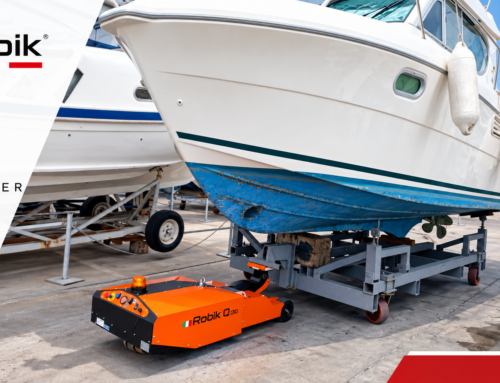

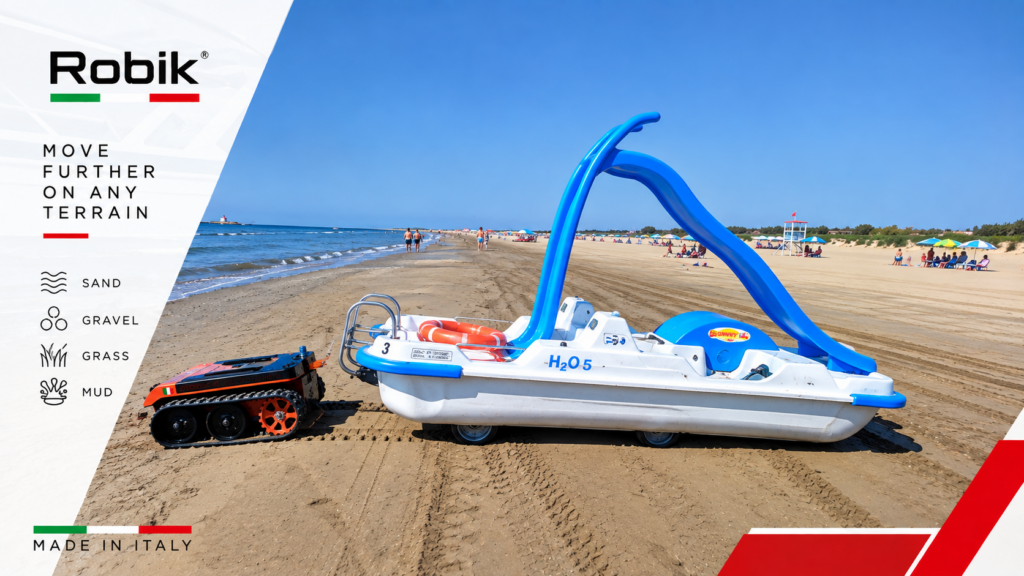
Case history: a tracked electric solution for moving pedal boats, jet skis, inflatable boats and small craft on sand and other challenging terrain
Moving pedal boats, jet skis and small boats on sand requires a handling system capable of maintaining traction on soft ground, where the wheels of a conventional vehicle may sink or lose grip.
Under these conditions, the weight of the boat is not the only factor to consider. Ground contact area, ground pressure, traction and surface conditions all become essential when selecting the most suitable handling system.
This is the challenge encountered in marine applications where pedal boats, jet skis, inflatable boats and small craft need to be moved across sand, gravel, wet grass, mud and other challenging surfaces.
The challenge: moving a load over soft ground
Moving a boat across a smooth industrial floor is very different from moving it across a beach or natural terrain.
On sand, for example, wheels with a relatively small contact area can exert high pressure on the ground and tend to sink. As the wheels sink deeper into the surface, resistance to movement increases and maintaining traction can become more difficult.
Similar conditions can occur on gravel, wet ground, grass or mud, where the surface may be uneven and provide significantly different levels of traction.
The challenge, therefore, is not simply to find a sufficiently powerful machine. The handling system must be able to transfer the required force to the ground under the actual operating conditions.
The solution: a tracked electric mover
For applications of this kind, a Robik tracked electric mover can be used to operate on surfaces where a conventional wheeled configuration may experience greater difficulty.
The principle is mainly related to the larger ground contact area provided by the tracks.
By distributing the load over a wider area, tracks can reduce the specific pressure exerted on the ground compared with narrow wheels and improve the mover’s ability to travel over soft or uneven terrain.
The tracked configuration also provides a larger contact area through which tractive force can be transferred to the ground, an important factor when moving loads over sand, gravel, wet grass or mud.
Why are tracks useful on sand?
On a hard and even surface, wheels can provide a highly efficient solution. On sand, however, the situation changes.
A wheel tends to concentrate the load over a relatively small area. If the ground is not sufficiently compact, it can deform under the weight of the machine, increasing resistance to movement.
Tracks distribute the load over a larger contact area, helping to limit sinking and maintain more consistent traction.
This does not mean that any tracked vehicle can operate on any type of sand. Grain size, compaction, moisture, gradient and the weight to be moved must always be evaluated.
For this reason, when operating on challenging terrain, selecting the right mover should begin with an assessment of the actual conditions along the route.
Not only sand: gravel, grass and mud
The same challenge can arise at beach resorts, boat storage facilities, campsites, marinas and facilities located near beaches or lakes, where the route between the storage area and the water is not always paved.
A small boat may have to cross several different surfaces during the same movement: a paved section, a grassy area, gravel and finally the beach.
In these situations, the ability to operate over different and uneven surfaces becomes an important factor when selecting the handling system.
What should be considered when moving a boat on sand?
Weight remains an important parameter, but it is not sufficient on its own.
Before selecting the handling system, it is necessary to evaluate the total load weight, connection to the mover, characteristics of the trolley or cradle, type of terrain, sand compaction, gradient, presence of mud or water, available traction and route length.
Conditions can also change over time. A surface that is easy to cross when dry may behave very differently after rain or when the ground is saturated with water.
For this reason, the system should be sized according to operating conditions that are representative of the actual application, rather than considering only the weight of the boat.
Do you need to move pedal boats, jet skis or small boats on sand?
Every beach, boat storage facility and marine site presents different operating conditions. Terrain, gradient, load weight, route and towing method should therefore be assessed together to identify the most suitable configuration.
When the route includes sand or other soft surfaces, a tracked solution can provide characteristics particularly suited to moving pedal boats, jet skis, inflatable boats and small craft over challenging terrain.
Do you have a similar marine handling challenge? Contact Robik: we will analyse your application and work with you to identify the most suitable solution.