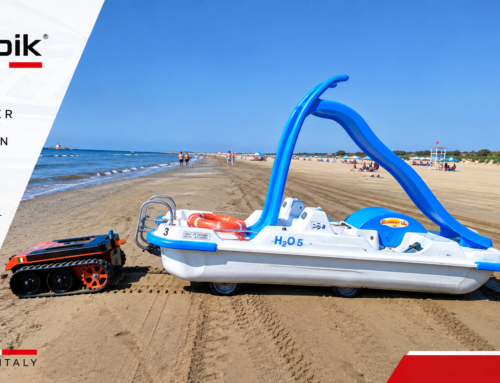


Case history: how to handle boats on cradles in a dry storage facility using two different configurations — radio-controlled and tiller-operated — depending on the available space and manoeuvring requirements
Moving boats in confined spaces requires a system capable not only of generating the force needed to move the load, but also of providing precise control of the cradle during manoeuvres.
In dry storage facilities, boatyards and marinas, boats often need to be moved through closely spaced storage positions, narrow aisles and areas with limited manoeuvring space.
In a real-world marine application, the presence of different operating conditions within the same facility led to the adoption of two Robik configurations: a radio-controlled version and a version equipped with the TVC – Timone a Volta Corretta system and tiller steering.
The challenge: moving boat cradles when space is limited
When a boat is moved on land, the dimensions of the vessel itself are not the only factor to consider.
The entire system — boat, cradle and handling equipment — must be evaluated, together with the space required for turning, correcting the trajectory and entering or leaving storage positions.
With conventional towing systems, articulation points between the towing vehicle and the cradle can also make trajectory control more difficult, particularly during pushing and positioning operations in confined spaces.
The requirement was therefore to find a compact solution capable of moving boats on cradles while adapting to the different operating conditions within the storage facility.
The solution: two Robik configurations for different manoeuvring requirements
For this application, a single configuration was not used.
Instead, two different Robik solutions were adopted to meet specific operating requirements: a radio-controlled version and a version equipped with TVC – Timone a Volta Corretta, operated by a tiller.
The radio-controlled configuration allows the operator to move around the boat during the manoeuvre, choosing the position that provides the best view of the vessel, cradle, trajectory and surrounding obstacles.
This is particularly useful when visibility changes during the manoeuvre or when the boat needs to be moved close to other vessels or structures.
When is the TVC configuration used?
For other handling conditions, the configuration equipped with TVC – Timone a Volta Corretta was adopted.
In this configuration, the mover is operated using a tiller, and the system is designed to provide direct control over the trajectory of the cradle during manoeuvring.
This becomes particularly important when a boat needs to be positioned within a confined space, where the geometry of the connection between the mover and the cradle can also influence the trajectory.
The challenge, therefore, is not simply to move the required weight. It is also necessary to control the behaviour of the cradle during towing, pushing and positioning operations.
Radio control or tiller steering: which configuration should be used?
The case shows that the choice does not depend solely on the weight of the boat.
The most suitable configuration should be evaluated according to the layout of the facility, cradle geometry, aisle width, type of manoeuvre and visibility available during movement.
The radio-controlled version allows the operator to freely choose their position in relation to the load during the manoeuvre.
The TVC tiller-operated configuration, on the other hand, provides a different method of controlling the trajectory of the cradle.
Within the same storage facility, both configurations were therefore adopted to meet different operating conditions.
What should be considered when moving a boat in confined spaces?
Boat weight is only one of the parameters that must be evaluated.
Selecting the correct handling system requires consideration of the combined weight of the boat and cradle, cradle geometry, wheels, rolling resistance, ground conditions, gradients, aisle width, storage-space dimensions and the connection between the mover and the cradle.
In particularly confined areas, it is also important to evaluate the geometry of the entire system while turning, because a compact mover alone is not sufficient if the complete mover-and-cradle combination requires excessive manoeuvring space.
Do you need to move boats in confined spaces?
Every dry storage facility, boatyard and marina has different operating conditions. For this reason, the weight of the boat should not be considered in isolation: the entire application must be evaluated, including the cradle, travel path, available space and required manoeuvres.
The possibility of choosing between different configurations makes it possible to identify the system best suited to the actual operating conditions.
Do you have a similar marine handling challenge? Contact Robik: we will analyse your application and work with you to identify the most suitable solution.