
Precast concrete beam handling: why controlled braking is essential and how the ROBIK Q130 remote-controlled electric tug can provide an effective alternative to traditional forklifts
Moving a 40-ton load on rails can be easier than you might think. Thanks to low rolling resistance, the force required to move such a heavy load can be relatively low.
The real challenge is not simply moving the load, but controlling its speed and, most importantly, stopping it precisely and safely.
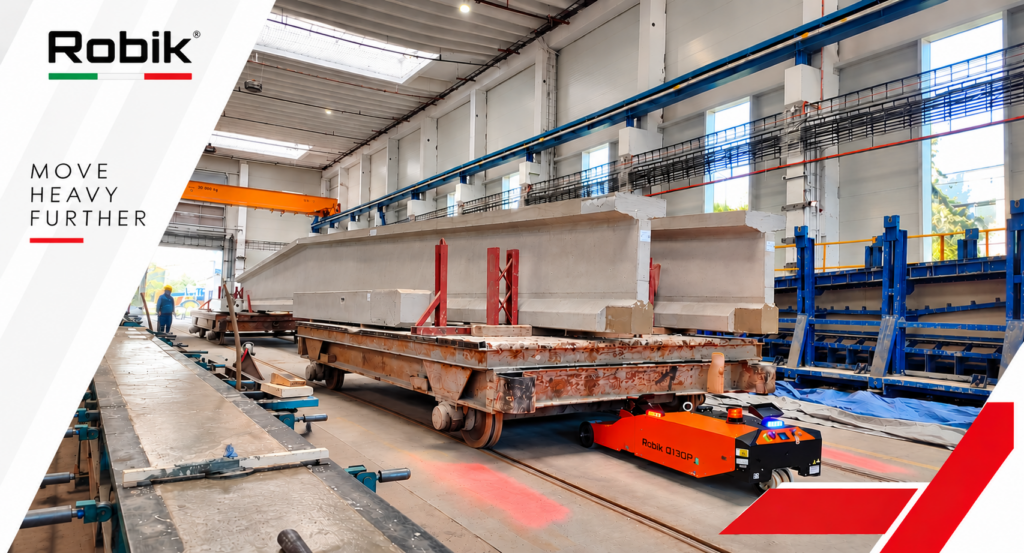
This was the challenge faced in a real industrial application in the precast concrete construction sector, where long concrete beams weighing approximately 40 tons are moved along rails using the ROBIK Q130 remote-controlled electric tug.
Why Is It Easier to Move 40 Tons on Rails Than to Stop Them?
When a load moves on rail-mounted wheels, rolling resistance is generally very low. This allows extremely heavy loads to be moved with relatively limited traction force, especially on level tracks.
However, low rolling resistance combined with the high inertia of the load makes controlled braking essential.
Even at low speeds, a 40-ton load requires adequate braking force to slow down and stop safely.
For this reason, industrial rail-based material handling requires more than just sufficient towing capacity. It is essential to consider movement precision, controlled deceleration and operator safety.
What Are the Limitations of Forklifts for Heavy Load Handling on Rails?
In this application, the precast concrete beams were previously moved using a forklift, which presented three main challenges:
- Braking control: difficulty in precisely managing the deceleration and stopping of such a heavy load.
- Limited visibility: the forklift operator could not maintain a complete view of the handling area from the driver’s cabin.
- Bulky dimensions: the forklift required additional manoeuvring space, reducing operational flexibility inside the facility.
These limitations led to the search for a more compact, precise and suitable solution for heavy load handling on rails.
How Does ROBIK Q130 Improve Safety and Control in Heavy Load Handling?
The solution adopted was the ROBIK Q130 remote-controlled electric tug, designed for handling heavy and oversized industrial loads.
Thanks to its technical features, ROBIK Q130 addresses the main limitations of the previous handling system:
- Precise movement and controlled braking: progressive control of speed, deceleration and stopping.
- 360° operator visibility: remote control allows the operator to choose a safe position while maintaining a clear view of the entire working area.
- Compact design: reduced dimensions compared to traditional forklifts, providing greater flexibility in confined industrial spaces.
- Electric technology: an efficient solution suitable for indoor industrial material handling.
Can a Compact Electric Tug Move a 40-Ton Load?
Yes, under suitable operating conditions.
This application demonstrates how the ROBIK Q130 can move approximately 40 tons on rails, thanks to the low rolling resistance of the rail system.
It is important to understand that the weight a tug can move does not depend solely on the mass of the load, but on the traction force required by the specific application.
Rolling resistance, gradients, traction conditions and braking capacity are essential factors to consider to ensure safe and effective load handling.
Do you need to move heavy or oversized loads within your production facility?
Discover how ROBIK solutions can improve safety, precision and efficiency in your industrial material handling operations.